April Fools’ Day
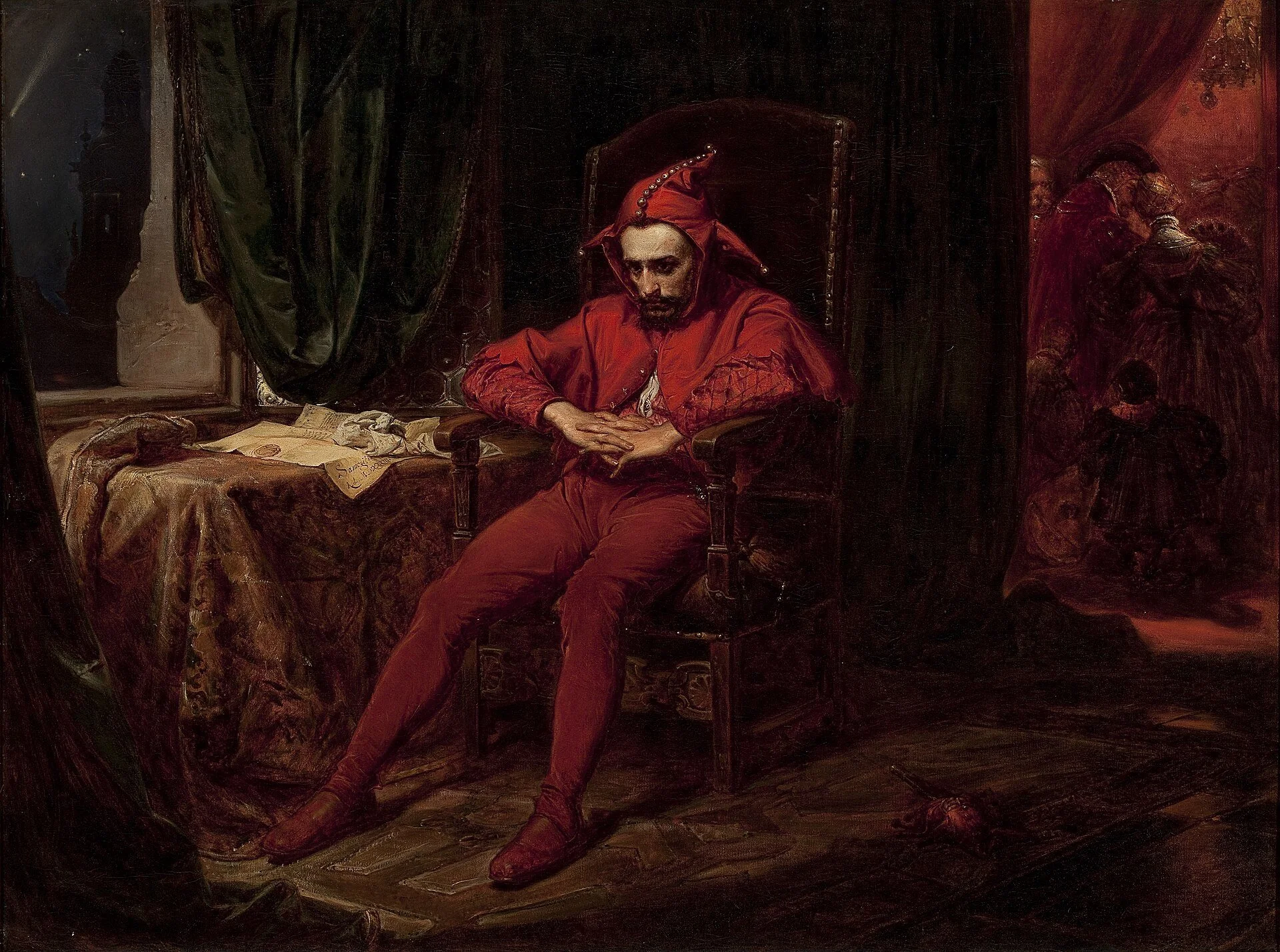
My cartoon is inspired by Jan Matejko’s painting, Stańczyk during a ball at the court of Queen Bona in the face of the loss of Smolensk, but is more commenly known as The Fool, pictured below.
The painting’s story centers on the court jester Stańczyk, whom Matejko mistakenly placed under Queen Bona’s service. He was actually the jester for King Sigismund I. The painting shows a jester lost in thought, with a lively palace ball unfolding behind him. Beside him on the table, a letter proclaimed Smolensk’s capture by the Russians.
The color red is the central visual element in Matejko’s painting. The vibrancy of red’s color is intensified next to the muted green, shifting a bit towards yellow. To make a key color pop, painters place complementary colors adjacent to it. According to some painters, the aesthetic quality of colors suffers when two complementary hues are positioned adjacently. Some think that using color combinations slightly off from complementary creates a shimmering effect. In any event, Matejko excels at employing color, and his red is remarkably beautiful.
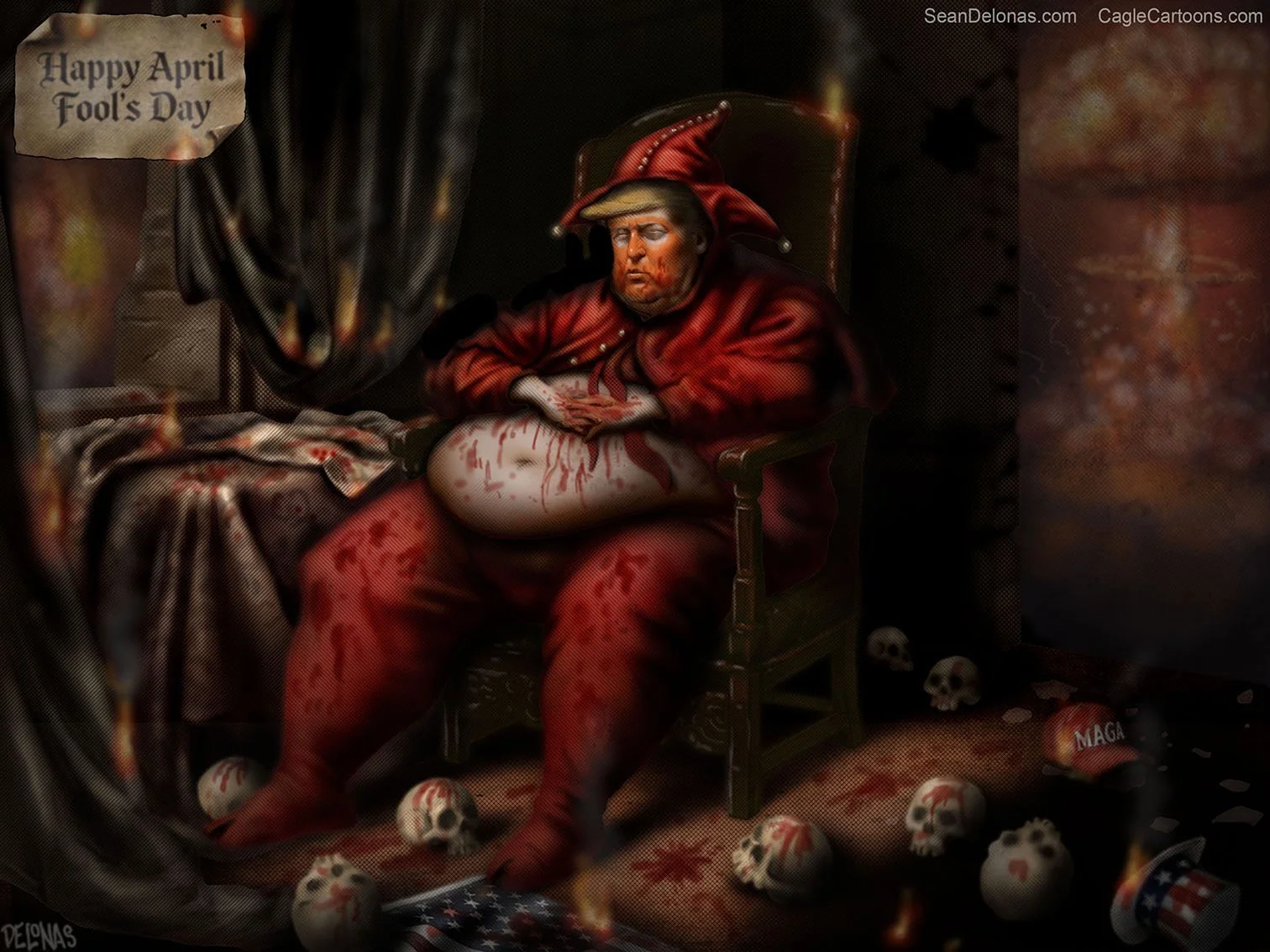
Regarding the cartoon, “Fools’” is usually plural for April Fools’ Day. However, the cartoon uses the singular “Fool’s” because the cartoon specifically centers on Trump. The vibrant ball in the background was substituted with the smoke and flames of the Iran war. To prevent the smoke and fire’s warm tones from competing with the costume’s red, the chroma was reduced to the lowest possible level. I unsuccesfully attempted to transform the letter about the Smolensk tragedy into a map of Iran. However, due to its diminutive size and an angle that rendered it unreadable, I ultimately decided to leave it as plain paper, mirroring Matejko’s approach with the letter. The ground is covered in blood symbolizing needless war deaths, staining the American flag, a MAGA hat, and Trump himself.